
Hundreds of thousands protest in Prague against plan to fund Czech public media from state budget
Organisers say more than 350,000 people joined the rally against a government plan to replace the licence fee that funds public broadcasters, which the government says will not affect editorial independence.
By Juan de la Torre, Prague
3 min read
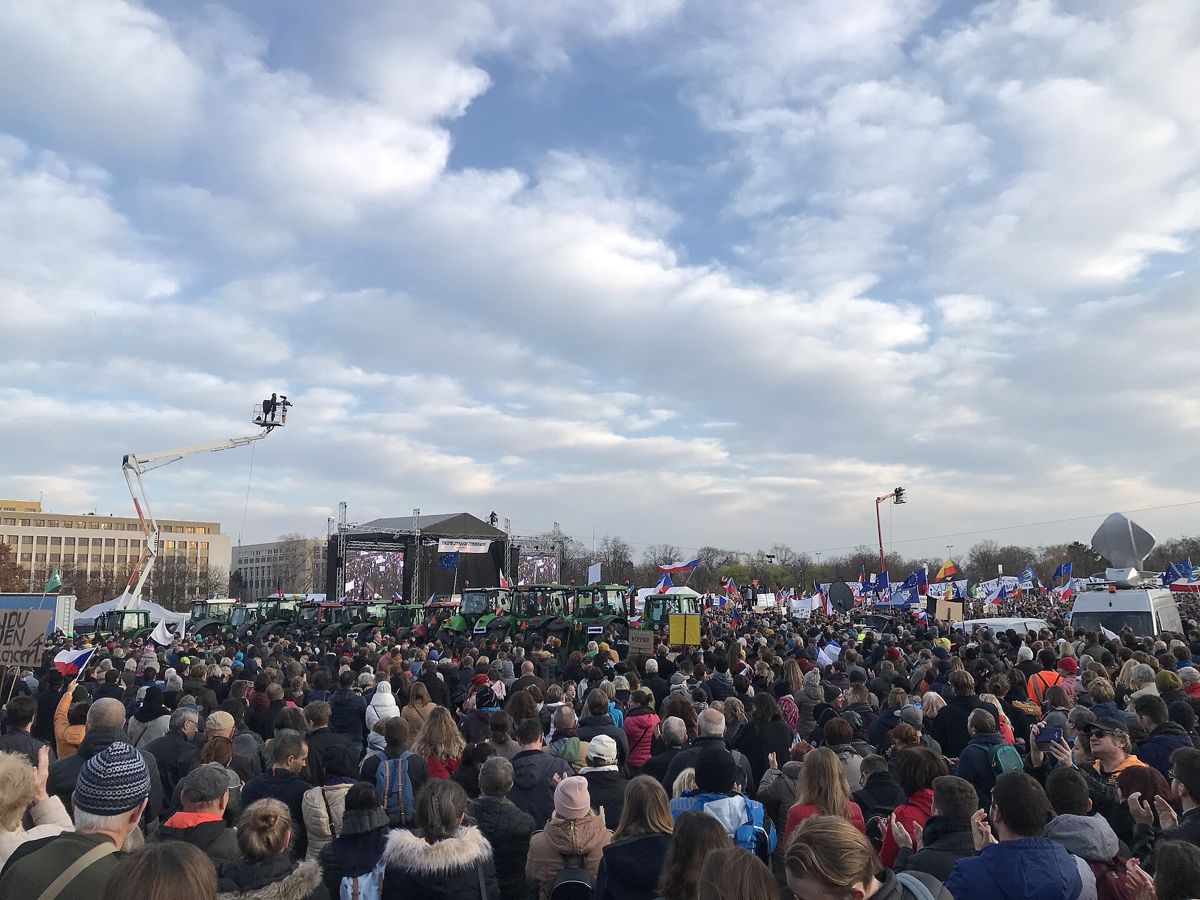
Hundreds of thousands of people rallied in central Prague on Sunday against a government plan to scrap the mandatory licence fee that funds Czech public television and radio and to pay for them from the state budget instead. Organisers said more than 350,000 people attended, according to reports. The Million Moments for Democracy group, which called the protest, later gave another figure of "roughly 400,000". One account described the crowd as thousands of people.
The rally took place at Letná Plain, the site of mass demonstrations during the 1989 Velvet Revolution that ended more than 40 years of communist rule. Many participants wore triangular paper hats modelled on Večerníček, an animated character who presents the bedtime stories on the public television channel. Others carried banners reading "We won't give media away" and "We refuse the Slovak scenario".
The government is led by Prime Minister Andrej Babiš, a billionaire who returned to power last year. The coalition, described in reporting as populist and right-wing Eurosceptic, includes his ANO (YES) movement, the rightwing Motorists for Themselves and the anti-migrant, pro-Russian Freedom and Direct Democracy party, according to reports. Czech households currently pay 205 koruna (about £7) a month for public broadcasting, according to reports.
The bill's first reading was approved in late October. Reports say it was pushed through in the middle of the night, and that parliament passed the first draft late last month. Since then, protests have been held in towns and cities, and staff at the public television and radio broadcasters have held a strike, according to reports. The government says the change will not affect editorial independence but wants broadcasters to cut costs. The proposal would reduce state television and radio budgets by about 15%, according to reporting.
Protesters argue that funding from the state budget would give ministers more leverage over newsrooms. They point to Hungary, Poland, Serbia and Slovakia, where governments have, according to reporting, eroded media independence. The European Broadcasting Union, the European Federation of Journalists, Reporters Without Borders and the International Press Institute have criticised the plan, comparing it to moves by Slovak Prime Minister Robert Fico and former Hungarian premier Viktor Orbán. Critics have also pointed to Hungary under Orbán, who tightly controlled state media, as reporting notes.
Babiš has rejected these claims. He told a national news agency that "no one wants to nationalise them" (translated from Czech). Reports say he told protesters they were stirring up the public with unfounded claims, and that in an op-ed he wrote last week he stated: "Under no circumstances will we interfere in editorial work." Reporting notes that France removed its licence fee in 2022 and that Norway abolished its fee in 2020, moving broadcaster funding into the state budget.
The organisers said the authorities would now see the scale of opposition. Mikuláš Minář, the lead organiser, said: "It's just a beginning." In a statement, the group demanded that the government withdraw the plan. ANO still has the support of about 30% of voters in opinion polls, according to reporting, despite the protests.