
SpaceX catches top of Starship rocket on return to Earth for first time
According to the BBC, the upper section was caught by the launch tower's mechanical arms after a flight of about 22.5 hours, but the booster was lost in the ocean.
By Carmen Pardo, Boca Chica, Texas
3 min read
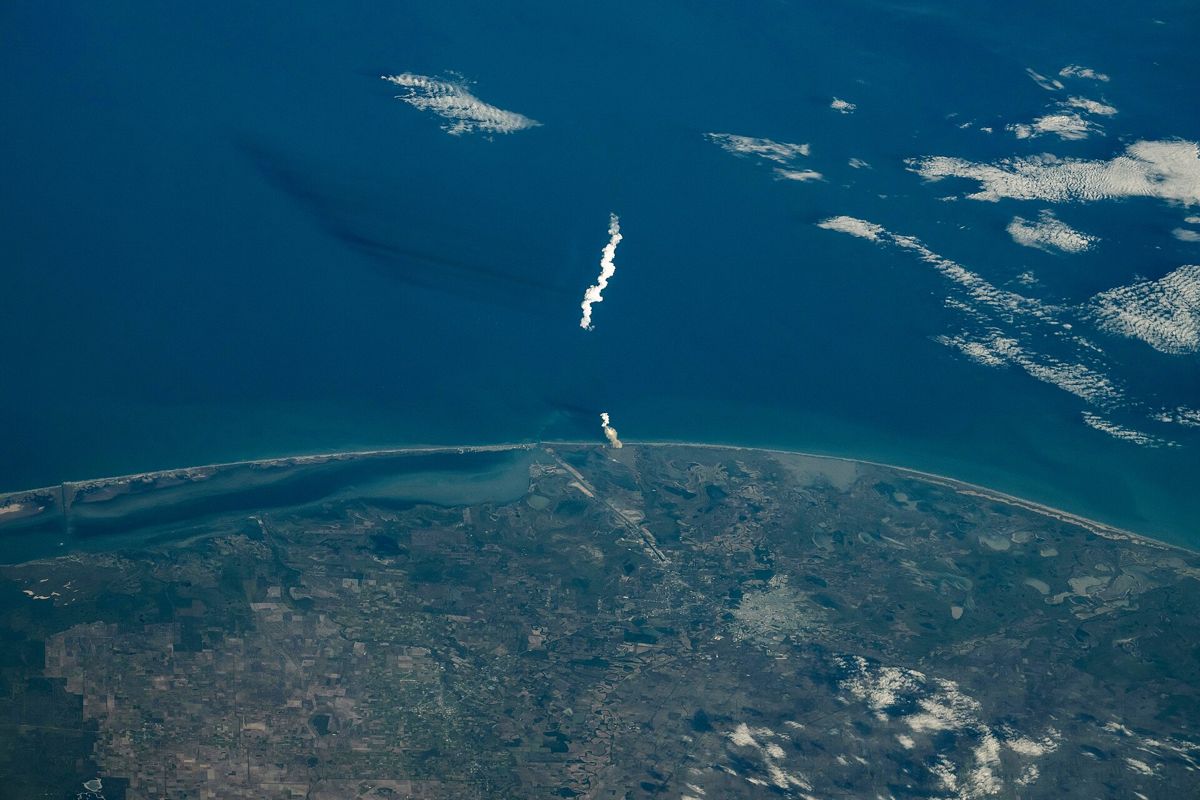
SpaceX has caught the upper part of its Starship rocket as it returned to Earth, a first for the company, according to the BBC.
The upper section, known as the Ship, came back to the launch tower at Starbase in Boca Chica, Texas, at around 15:27 local time (21:27 GMT) on Saturday, a few minutes behind schedule. It hovered near the tower before the mechanical arms, nicknamed "chopsticks", secured it. The BBC reported that large crowds cheered at the site, and a commentator was heard saying "Can you believe it?"
The flight began on Friday at 16:47 local time, when the 124-metre rocket lifted off. The Ship then completed 14 orbits over roughly twenty-two and a half hours, deploying 26 satellites that form part of Starlink, SpaceX's high-speed internet network.
SpaceX had hoped to recover both halves of the rocket on the same flight. The bottom section, the Super Heavy booster, was due to be caught about six and a half minutes after launch. Instead, the booster triggered an automated abort and was diverted to the ocean. The BBC's reports describe its end differently: one says it hovered above the water before exploding, while another says it burst into flames just above the sea. Elon Musk later wrote on X that the booster was "slightly low on fuel".
Professor Malcolm Macdonald, president of the Royal Aeronautical Society, told the BBC that losing the booster was a setback, but that the successful return and recovery of the Ship was a substantial step forward. The two halves of the recovery challenge have now been demonstrated, he said, though not yet on the same flight.
This was the 15th test of Starship and the first attempt to recover both stages in full. SpaceX has caught the booster on three earlier test flights, but the Ship reached orbit for the first time only in September. The company wants both sections to be fully reusable, which it sees as the route to much lower launch costs. Its Falcon 9 rockets already fly more than 100 times a year.
The result matters for NASA, the US space agency, which has contracted SpaceX to convert the Ship into a lunar lander for astronauts. NASA is aiming for a crewed Moon landing in 2028, and the Artemis III mission is currently planned for summer 2027. Blue Origin, the company owned by Jeff Bezos, also holds a lunar lander contract. Its New Glenn rocket exploded earlier this year, destroying its launchpad in Florida, and its return to flight has been delayed to early 2027.
NASA's administrator, Jared Isaacman, has said the United States is in a race with China, which plans to land Taikonauts on the lunar surface by 2030. The BBC notes that SpaceX became a public company earlier this year, so its shareholders will also be watching the programme closely.